Caliche, Compaction and Why the Slab Cracks
Most slab cracks in El Paso start below the concrete, not in it.
September 2, 2026 · 3 min read
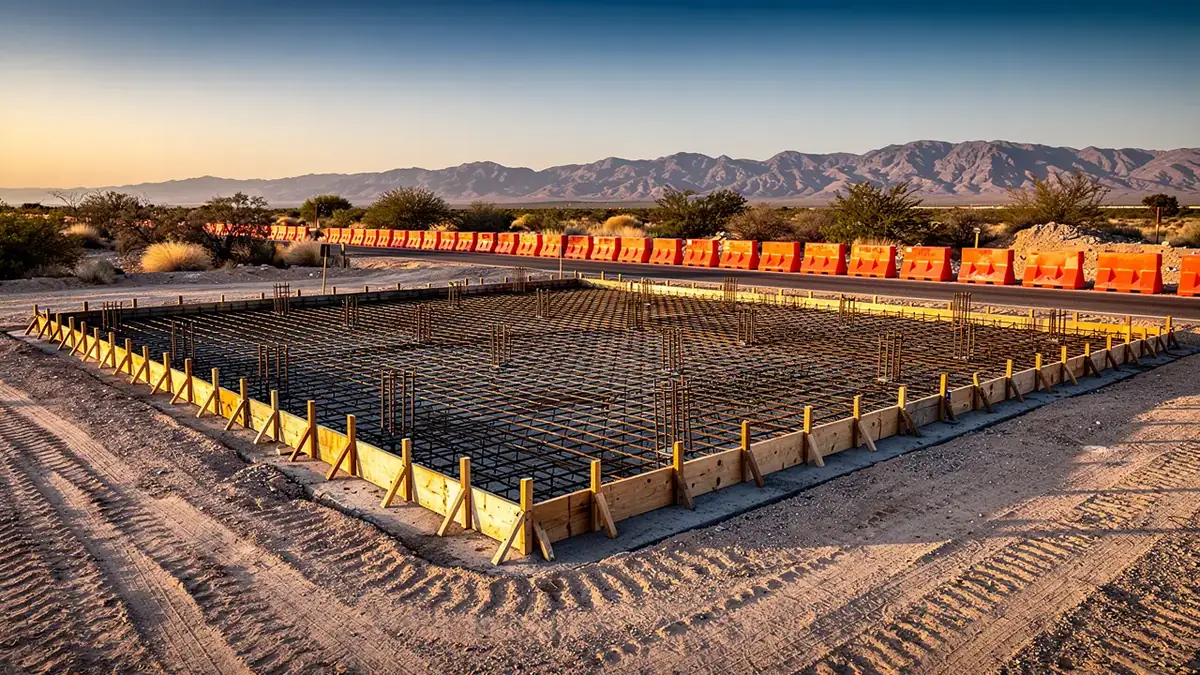
Ask most property owners in El Paso why a slab cracked and they will blame the concrete. Wrong mix, wrong cure, a contractor who poured too fast. Sometimes that is true. Far more often the concrete did exactly what concrete does when the ground underneath it moves, and the ground underneath it moved because nobody dealt with it before the forms went up.
What is actually under an El Paso job site
A lot of the soil across El Paso, Hudspeth and Brewster counties sits on caliche, a hardened layer of soil cemented together by calcium carbonate. In its natural state caliche can be dense enough to need equipment to break, which is part of why it gets treated as a strong base. The problem is that caliche is not uniform. Pockets of it are hard and stable. Others are soft, chalky or mixed with expansive clay that swells when it gets wet and shrinks hard when it dries out. A slab poured over an unverified mix of the two is a slab poured over ground that will move at different rates in different places.
Why the cracking pattern tells a story
A crack that runs diagonally from a corner, a slab that has heaved on one side, or a sidewalk section that has dropped relative to its neighbor is almost never a defect in the pour itself. It is differential movement in the subgrade, meaning one section of ground settled or swelled more than the section next to it. Uniform, well compacted fill moves together, if it moves at all. Untested fill moves however each pocket of soil underneath it decides to move.
Grading and compaction come before forms, not after
The order matters. Subgrade needs to be graded to the correct elevation and slope, proof rolled to find soft spots, and compacted in controlled lifts, not just bladed flat and called ready. Compaction should be verified, not assumed, because a subgrade that looks flat and firm on the surface can still be loose two feet down. Skipping this step to save a day on the schedule is the single most common reason a new slab, a new curb, or a new stretch of sidewalk starts cracking within its first year instead of its twentieth.
Why it matters that the same crew does both
Grading, earthwork and concrete are often bid and performed as if they were unrelated trades. That separation is exactly where responsibility gets lost. If the earthwork contractor grades the pad and a different concrete crew pours it, and the slab cracks eighteen months later, the two companies will point at each other while the property owner pays for the repair either way. EGL Construction self performs both the earthwork and the concrete work, so concrete and earth services, including grading, curb and gutter, sidewalks and concrete paths, sit under one contract with one crew accountable for the ground and what gets poured on top of it.
What to ask before you sign a concrete contract
- How is the subgrade being prepared before forms go up, and who is doing that work?
- Is compaction tested, or just visually inspected?
- Does the contractor self perform the earthwork, or is it subcontracted separately from the pour?
- What is the plan if a section of ground turns out to be softer or more expansive than expected?
None of this shows up in a finished slab on the day it is poured. It shows up two winters later, in the crack that runs from the corner of a loading dock or the sidewalk panel that has started to lift. Asking about subgrade prep before the work starts costs nothing and tells you more about a contractor than the finish on the concrete ever will. EGL Construction serves El Paso, Hudspeth and Brewster counties and offers free estimates. Call 915-525-2302 to talk through a specific site.
EGL Construction Inc., (915) 525-2302
Call (915) 525-2302More articles
What Cooperative Purchasing Actually Means for a Public Buyer
Cooperative purchasing lets a public agency use work someone else already vetted. It does not remove your job, it changes it.
What a Vactor Truck Does, and When You Need One Instead of a Digger
Clearing a blocked line is not always a job for a backhoe. Sometimes vacuum does it without opening the ground.